
SEND THE DETAILS
Share a nameplate photo, the location, and whatever you know about your equipment. No testing is required from you.
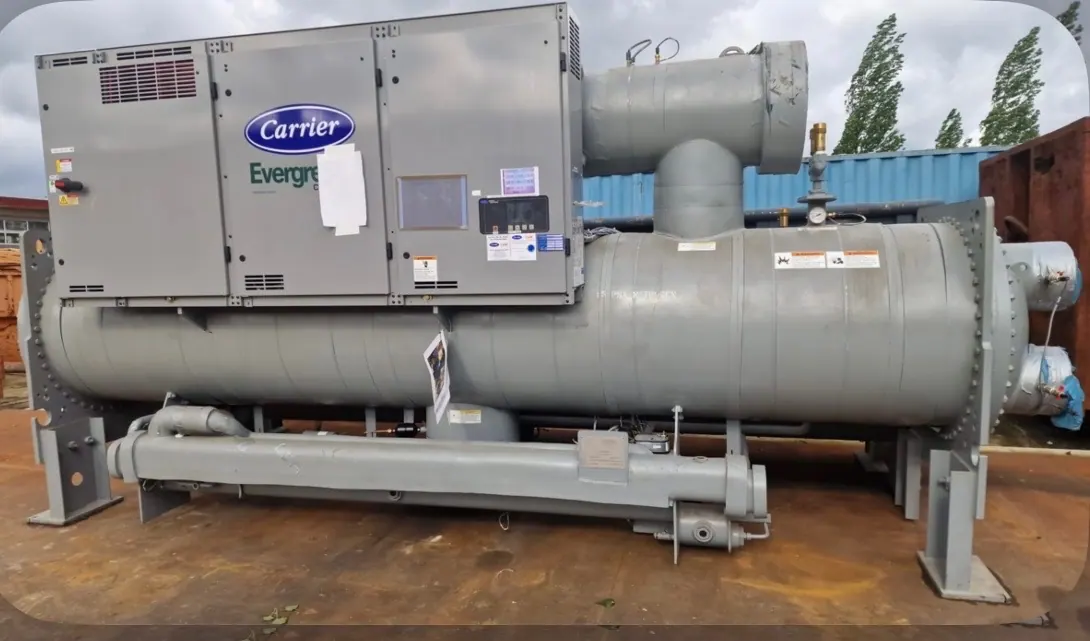
We buy chillers marked R-12 in Austin, Texas, with cash offers and upfront payment when a purchase is agreed. We handle removal, and the seller does not need to test the equipment.
From first photo to final haul, we take care of the details so you can move forward.
Share a nameplate photo, the location, and whatever you know about your equipment. No testing is required from you.
We review the chiller and your site information, then make an offer. Payment is upfront.
We handle disconnects, refrigerant recovery, crane and rigging, loading, freight and hauling.
For an initial review, begin with the equipment label rather than trying to establish whether an older chiller still runs. Send a readable photo of the refrigerant marking and the manufacturer nameplate, including model and serial numbers if visible. If the unit is described as R-12 but the tag is faded, incomplete, or inconsistent with service records, report that plainly. Do not open the refrigerant circuit or guess at the charge.
Also share the chiller’s approximate capacity, configuration, and location within the property, if known. Capacity in tons measures cooling output; it does not tell us the machine’s weight or the lifting plan. We consider industrial and commercial water-cooled and air-cooled chillers, including centrifugal, screw, and scroll equipment, across a broad range of capacities and refrigerants. An R-12 marking is useful information, not by itself a purchase decision.
Tell us whether the chiller is operating, idle, disconnected, incomplete, or non-running, and mention visible damage or missing components. If you know when it last ran or why it was taken out of service, include that history; if you do not, say so. Photos of the overall unit, labels, and visible condition can help us understand what is being offered without requiring a test, repair, cleaning, or restart.
Records such as service notes, conversion documents, or equipment schedules may clarify an older refrigerant identification, but they are helpful rather than a prerequisite to the first discussion. The current charge and the equipment’s internal condition cannot be established from a label alone. Leave the system closed: the seller should not vent refrigerant or attempt to recover it.
Identify the owner or authorized representative who can agree to sell the chiller, and the site contact who can approve access and coordinate the work. Those roles may belong to different people. Let us know what equipment is included in the proposed sale, including any loose parts offered with it, and whether other connected plant equipment must remain in place.
This early boundary-setting matters if the chiller sits in an active mechanical room or shares space with equipment that is staying. Explain any known operating restrictions, access rules, or approvals that apply. The authorized site contact supplies accurate information, access, site requirements, and necessary permissions; we coordinate the equipment work with that contact.
Describe how the chiller is positioned and what is known about getting it out: floor or roof level, door and corridor limits, stairs, loading areas, and possible staging space. A unit in a basement, enclosed plant room, or rooftop location may call for a different removal sequence. Those details need review at the actual property; a photograph or capacity rating cannot confirm a workable route.
If the equipment is on a roof or requires a lift, share useful site photos and any known restrictions on crane placement, access windows, overhead clearance, or ground support. Do not assume a crane is either needed or feasible before the location is assessed. We arrange appropriate rigging, crane work when needed, loading, freight, and hauling as part of an agreed purchase and removal scope.
For an occupied facility, flag delivery traffic, work hours, security procedures, and areas that must stay open or in service. If the chiller is part of a plant replacement, identify the outgoing unit and the expected changeover timing. A schedule can help coordinate access, but the pickup date and sequence still depend on the site’s actual conditions and approvals.
We arrange appropriate refrigerant recovery with qualified personnel and coordinate necessary disconnects, rigging, removal, and transport. The seller does not need to hire a recovery provider, crane company, or hauler, and is not expected to test or restart the chiller. Work methods and timing are confirmed against the equipment, surroundings, and site rules.
Once the equipment and proposed removal are reviewed, we can discuss whether to make an offer. Any cash offer depends on the specific asset and actual project review; it is not guaranteed. If we agree to purchase, payment is made upfront before pickup on the terms agreed by both sides. Confirm the amount, payment arrangements, equipment included, and removal responsibilities before scheduling the work.
To begin, gather the clearest nameplate and refrigerant-label photos available, a few views showing the chiller and its access route, and a short account of its known condition and location. Include the authorized seller and site contact in the discussion where practical. Incomplete records or a non-running unit do not prevent an initial review; accurate details help determine what can be agreed and how a safe, coordinated pickup could proceed.

Air-cooled or water-cooled. Centrifugal, screw or scroll. From single units to large shutdown projects, we buy industrial chillers across Texas.
Send us your chiller details and nameplate photos for a cash offer. Don’t worry if you don’t know every specification—we can start with what you have.
Call or text(614) 715-3047TEXT NAMEPLATE PHOTOS ↗Prefer email?
saleselectricalbuyers@gmail.com