
SEND THE DETAILS
Share a nameplate photo, the location, and whatever you know about your equipment. No testing is required from you.
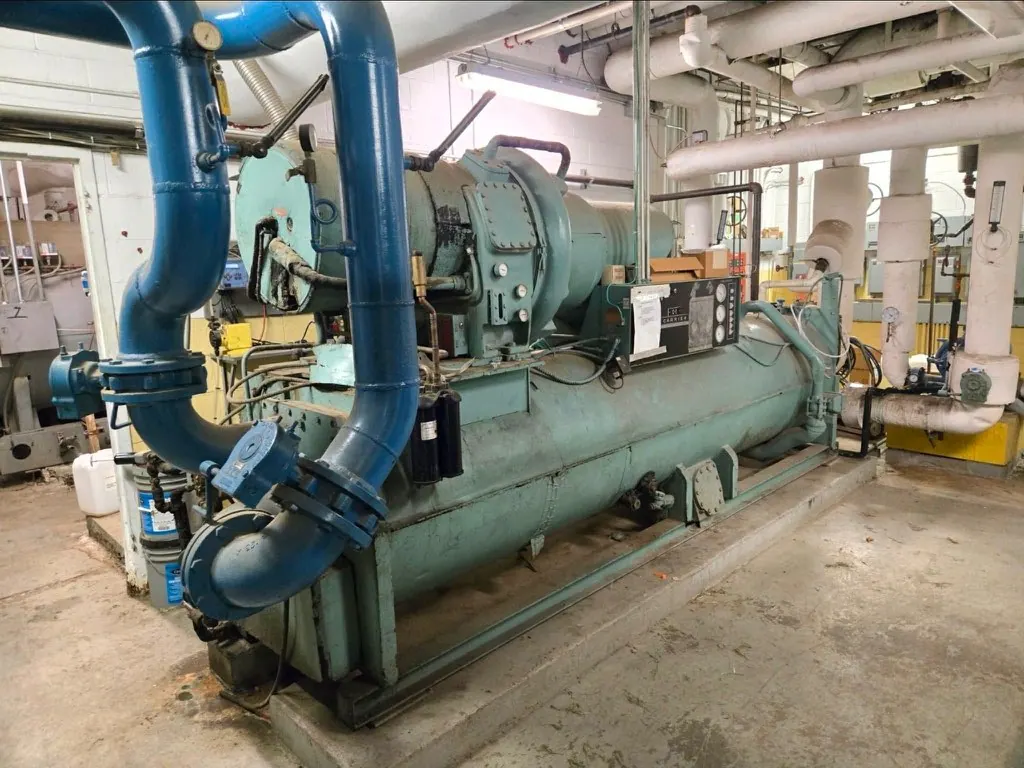
We buy used industrial chillers in Harris County, Texas, with cash offers and upfront payment when a purchase is agreed. We handle removal, and the seller does not need to test the equipment.
From first photo to final haul, we take care of the details so you can move forward.
Share a nameplate photo, the location, and whatever you know about your equipment. No testing is required from you.
We review the chiller and your site information, then make an offer. Payment is upfront.
We handle disconnects, refrigerant recovery, crane and rigging, loading, freight and hauling.
A chiller can be ready for sale even when it is idle, disconnected, incomplete, or no longer starts. We buy used industrial and commercial water-cooled and air-cooled chillers in Harris County, including centrifugal, screw, and scroll equipment. We consider all refrigerants and generally review machines from 20 to 2,000-plus cooling tons. An offer is subject to review; the range does not mean every unit will be purchased.
You do not need to restart, test, repair, or prepare the machine for operation. If it has been out of service for years, say so. If its history is unclear, share what is known and leave the gaps as unknown rather than estimating performance or refrigerant condition.
A cooling ton describes a chiller’s cooling capacity. It is not its shipping weight, a measure of how easily it can be removed, or enough information to determine an offer. Physical dimensions, configuration, included components, condition, and the planned work all need separate consideration.
For an initial review, gather the manufacturer and model information if readable, the unit type, stated capacity, refrigerant marking if visible, and a few photographs. Include the equipment’s present status and its pickup location within the property. Missing data is not a reason to guess; clear photographs and a candid description can help identify what still needs checking.
Handling depends on where the chiller sits and what lies between it and a loading area. It may be indoors or outdoors, connected to services or already isolated, and accessible by a direct route or through a constrained work area. Those are questions for the actual site, not assumptions based on the county or a capacity rating.
Photos showing the machine, surrounding clearance, exit route, and any visible overhead or doorway limits can make the first discussion more useful. Tell us about gates, access windows, active work areas, or site rules that may affect entry and removal. If the unit is near equipment or piping that must remain, identify those boundaries clearly.
Do not vent refrigerant or open the chiller’s refrigerant circuit to prepare it for sale. If a purchase is agreed, we arrange and handle appropriate refrigerant recovery using qualified personnel, along with necessary disconnects, rigging, crane work when needed, loading, freight, and hauling. The specific sequence depends on the equipment and site conditions.
Our team coordinates the equipment work with the person authorized to manage site access. The seller or site contact supplies accurate information, explains applicable rules, secures necessary approvals, and identifies services or nearby assets that are outside the sale. The seller is not being asked to hire a separate recovery, crane, or hauling crew for our removal scope.
If the chiller is part of a running plant or building system, explain what must stay in service and who can confirm the isolation boundary. Shared piping, controls, or adjacent equipment should not be treated as included just because they are close to the unit. For a replacement project, an expected availability window and the site contact’s work restrictions help establish whether the proposed pickup can be coordinated.
Access may be affected by occupied rooms, operating processes, stored materials, limited staging, or other conditions—but none should be presumed. Describe what is actually present and flag any required approvals or scheduling limits. We can review the proposed scope against that information before agreeing to a purchase or pickup plan.
A cash offer depends on the asset and the project review, including available identification, configuration, known condition, and removal requirements. It is not guaranteed, and cooling capacity alone does not set the amount. If the parties agree to a purchase, payment is made upfront before pickup, on the agreed terms.
Before work is scheduled, confirm which chiller and associated components are included, who has authority to approve the sale, and how the site will provide access. The agreed scope and timing should be clear to everyone involved. No payment amount or purchase decision should be assumed before that review.
A practical first message can include the nameplate or its readable details, overall and close-up photos, known condition, whether the unit is connected, and a brief description of the route out. Note the refrigerant label only if it is readily visible; do not remove panels or disturb the circuit to find it. Include any timing preference and the name or role of the person authorized to discuss access.
With that information, we can ask focused follow-up questions, review whether the equipment and removal scope may fit, and explain the next step toward a possible offer. There is no need to test or repair the chiller first. Accurate limits and unknowns are more useful than unsupported claims about condition or capacity.

Air-cooled or water-cooled. Centrifugal, screw or scroll. From single units to large shutdown projects, we buy industrial chillers across Texas.
Send us your chiller details and nameplate photos for a cash offer. Don’t worry if you don’t know every specification—we can start with what you have.
Call or text(614) 715-3047TEXT NAMEPLATE PHOTOS ↗Prefer email?
saleselectricalbuyers@gmail.com