
SEND THE DETAILS
Share a nameplate photo, the location, and whatever you know about your equipment. No testing is required from you.
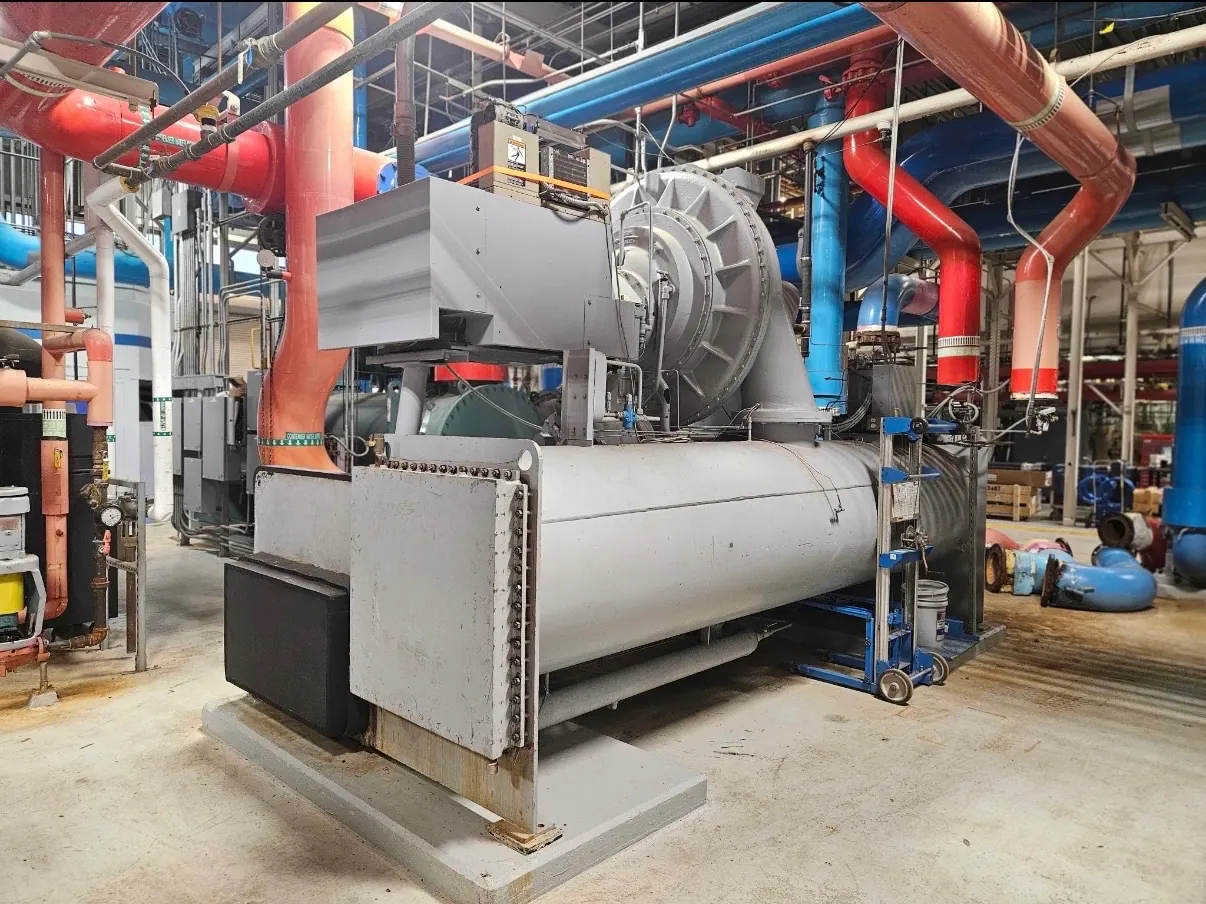
We buy district cooling plant chillers in Austin, Texas, with cash offers and upfront payment when a purchase is agreed. We handle removal, and the seller does not need to test the equipment.
From first photo to final haul, we take care of the details so you can move forward.
Share a nameplate photo, the location, and whatever you know about your equipment. No testing is required from you.
We review the chiller and your site information, then make an offer. Payment is upfront.
We handle disconnects, refrigerant recovery, crane and rigging, loading, freight and hauling.
District cooling plants can serve more than one building or process, and a chiller may sit among equipment that must stay in service. Before describing the sale, identify the particular machine you are offering and what belongs with it. Pumps, shared headers, controls, electrical gear, and neighboring chillers should not be treated as included unless that is actually part of the agreed scope.
A model and serial plate are useful, but you can begin with whatever is available: photographs, approximate capacity, manufacturer and model, refrigerant information if known, and a short account of the unit’s history. We consider water-cooled and air-cooled centrifugal, screw, and scroll chillers, generally from 20 to 2,000 or more tons, and consider all refrigerants. A cooling ton measures capacity, not the machine’s lifting weight.
If the chiller is idle, incomplete, or will not run, say so plainly. You do not need to test, restart, repair, or clean it to request a review. Don’t open the refrigerant circuit or vent refrigerant to find out what remains in the machine. If charge or service history is unknown, mark it as unknown rather than estimating.
In a shared plant, the connections can matter as much as the equipment tag. Tell us what you know about chilled-water and condenser-water piping, electrical feeds, controls, and any tie-ins to common systems. The site contact can clarify which valves or isolation points relate to the offered unit and which services must remain available to other equipment.
We coordinate appropriate refrigerant recovery with qualified personnel and arrange the necessary disconnects as part of the removal work. The actual sequence depends on the installation and on what the facility can safely isolate. The seller is not expected to hire a recovery contractor or disconnect the chiller independently. Accurate information about connections, operating restrictions, and the plant’s required shutdown window helps the parties define the work.
Tell us where the unit sits—indoors, outdoors, on a roof, or below grade—and describe the route from its current position to a loading area. Photos taken from safe, permitted locations can show door openings, turns, overhead obstructions, stairs, nearby equipment, and available staging space. Measurements are helpful when readily available; do not enter restricted areas or take measurements that require unsafe access.
A route that appears open on a drawing may be constrained by a column, low clearance, a narrow corridor, or another plant asset. If lifting may be necessary, the site contact can identify possible crane access and any property rules. The handling plan is reviewed for the actual site; no particular lift method should be assumed from the chiller’s capacity or location alone.
For an Austin project, share the access process that applies at the property rather than assuming a standard arrival or staging arrangement. Note required approvals, check-in procedures, work hours, safety rules, vehicle limits, and whether other operations will continue nearby. If the building is occupied or the plant must remain partly online, identify those limits early so the removal window can be discussed with the authorized contact.
The seller or site contact supplies accurate information, authorized access, applicable site rules, and necessary approvals. We coordinate the equipment work, including rigging, crane work when needed, loading, freight, and hauling. This division helps avoid confusion about who is arranging the physical removal and who can authorize work on the property.
A cash offer depends on review of the specific chiller and project; it is not guaranteed simply because the equipment fits a general capacity or type. Condition, completeness, known refrigerant details, included components, location, and access can all inform the review. If we agree to purchase, confirm in writing which asset and components are included, the agreed terms, the pickup scope, and the access plan.
Payment is made upfront before pickup on the agreed terms. The machine does not have to be operating for an initial review, but an offer remains subject to the information and project review. If ownership, authorization, or the boundary between the chiller and shared plant equipment is unclear, resolve that before scheduling removal.
To begin, send the equipment identification or best available description, a few current photos, known condition and refrigerant details, and a brief outline of the connections and route out. Include the site location in Austin and the name or role of the person authorized to coordinate access. If some details are not known, say so; the first step is to identify what needs clarification, not to guess at specifications or perform a test.
With that information, we can review whether the chiller and removal project may fit, ask focused questions, and discuss a possible offer. No purchase is assumed until terms are agreed, and no work should begin until access and site approvals are in place.

Air-cooled or water-cooled. Centrifugal, screw or scroll. From single units to large shutdown projects, we buy industrial chillers across Texas.
Send us your chiller details and nameplate photos for a cash offer. Don’t worry if you don’t know every specification—we can start with what you have.
Call or text(614) 715-3047TEXT NAMEPLATE PHOTOS ↗Prefer email?
saleselectricalbuyers@gmail.com